
Learn with UPROOT
Reading paths, discussion questions and ReGrowth pages to read alongside each piece. Use it on your own, with a reading group, or in a classroom or workplace.
Four ways to read together
Pick a path, read the pieces, then use the questions to talk it through or write it down.
A slow read
Read one path at a time and answer the questions in the digital workbook.
Teaching with zines
For older students and adult learners. Teacher workshops are coming soon.
The digital workbook
Every copy of UPROOT, print or PDF, comes with access to an interactive digital workbook to help you put its ideas into action.
Each copy contains a QR code for accessing the workbook
Four ways through the issue
Page numbers are from the print edition. Some pieces discuss weight stigma, family, desire and grief, so check in with your group before you start.
Starting out: what fat liberation means
Read in UPROOT
- Letter from the Editors, p.3. Catherine Doubell and Kate Asquith
- Finding Fat Liberation, p.43. Catherine Doubell with Jade, Nikita and Simran
Read alongside
Talk about
- Before reading, how would you have defined fat liberation? What changed?
- What’s the difference between body positivity and fat liberation, in your own words?
- Which idea from these pieces would you most want to explain to a friend?
Where body standards come from
Read in UPROOT
- Bodies Under Scrutiny, p.14. Catherine Doubell
- Willendorf Weeps, p.20. Isabel Stock
- Beyond the Mannequin, p.25. Catrin Haberfield, summarised by Kate Asquith
Read alongside
Systems, power and anti-fat bias · Beauty standards (coming soon)
Talk about
- Where did you first learn what a “good” body looked like?
- Who benefits from the standards these pieces describe?
- Which standard would you most like to uproot, and what would you put in its place?
Desire, pleasure and joy
Read in UPROOT
- The Joy of Feedism, p.31. Anonymous
- The Importance of Worthiness Pleasure for Black and Fat Women Seeking Romantic Relationships, p.36. Dr Dasha Carver
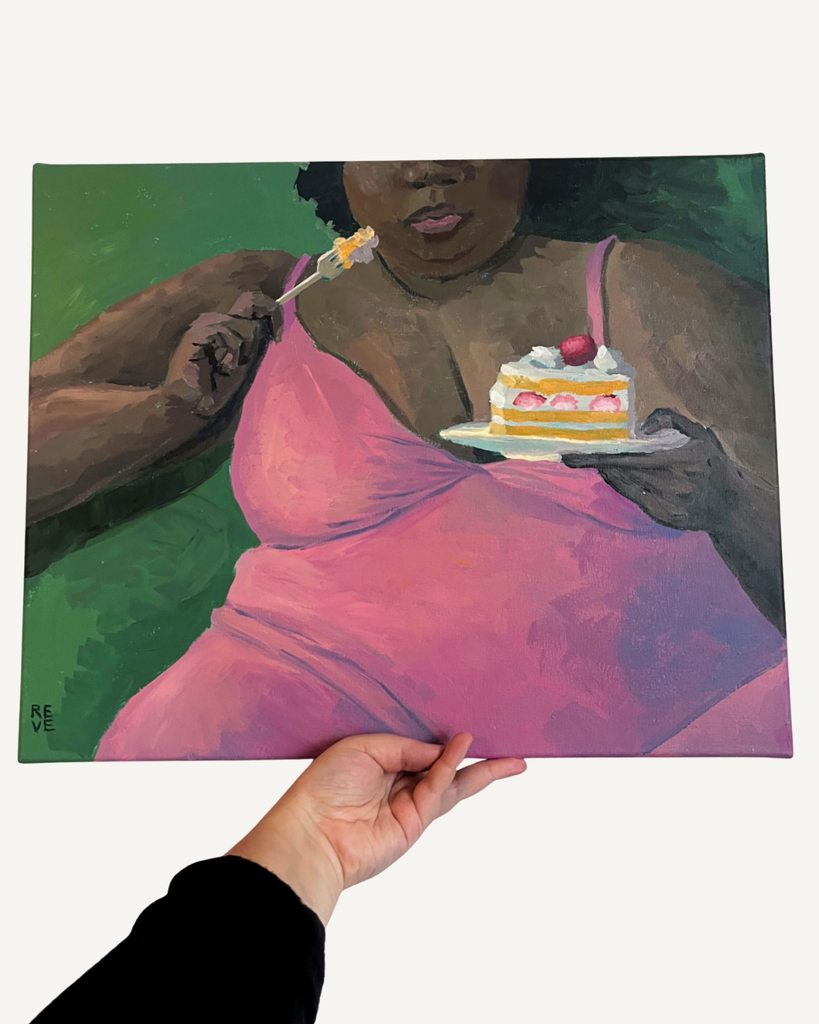
- Have the Cake and Eat It Too, p.39. Arte Gorda
Read alongside
Talk about
- Dr Dasha Carver writes about fat women being taught they can only be loved conditionally. Where do you see those conditions in everyday life?
- How do race and fatness shape who gets seen as desirable?
- What does fat joy look like in your own life or community?
Bodies across a lifetime
Read in UPROOT
- Traversing my ‘fatty’ memory lane, p.51. Ritash Achanta
- In the Event of a Family Gathering, p.53. Catherine Doubell
- My Body Pushing 70, p.58. Shirley Asquith
Read alongside
Talk about
- How have the messages you’ve heard about your body changed as you’ve got older?
- What role do family gatherings play in passing on ideas about bodies?
- What would you want a younger person in your life to hear?
Plus seven more pieces in the issue. See the full contents ↗
Running a reading group
Book clubs, community groups, staff networks or a few friends round a table.
- 1
Get copies
Order on waestm.co.uk, up to 15 per order. For more, or for bookshops and events, email us about bulk orders.
- 2
Agree how you’ll talk
Start from WÆSTM’s community guidelines: no diet talk, and content notes before difficult topics.
- 3
Read one path
Read before you meet, then work through the questions together. Finish with the workbook.
Want a ReGrowth facilitator to lead it?
We can run a session for your workplace, school or community group.